
8 Best ACT Prep Apps for Higher Scores and Smarter Study
Students preparing for the ACT often struggle with bulky test prep books and expensive tutoring sessions that don't fit their busy schedules. The best ACT prep apps transform smartphones into powerful study companions, offering targeted practice, personalized study plans, and flexible preparation that adapts to individual learning styles. These mobile tools provide efficient alternatives to traditional prep methods, helping students achieve higher scores through smarter study strategies.
Finding the right app among dozens of options can feel overwhelming, especially when many promise unrealistic results. The key lies in identifying which platforms offer genuine value through quality practice questions, adaptive learning technology, and comprehensive score analysis. For personalized guidance on selecting the most effective ACT prep tools based on individual strengths and weaknesses, students can consult an AI college counselor.
Summary
- Practice questions expose gaps but rarely fix them without targeted review. Students who complete 500 ACT questions often miss the same grammar errors or math concepts repeatedly because repetition without correction reinforces wrong patterns rather than eliminating them. Research on retrieval practice shows that testing alone produces weaker retention than testing combined with explanation. The difference between motion and improvement lies in how students analyze mistakes, identifying which specific rules or concepts they misunderstood rather than rushing to the next question set.
- Targeted study beats volume every time when students address root causes instead of symptoms. A student who misses seven punctuation questions, three sentence boundary questions, and two rhetorical skills questions gains more from reviewing punctuation rules and practicing targeted drills than from completing another 200 mixed questions. According to PrepScholar's ACT study schedules, students who target specific skill gaps rather than cycling through random question sets see measurable improvement within weeks because they concentrate effort where it creates actual score movement.
- Timing constraints reveal a different type of weakness than content knowledge alone. Students might understand coordinate geometry perfectly, but lose points when forced to solve problems in 90 seconds instead of five minutes. The ACT penalizes slow decision-making as much as incorrect answers, which means pacing strategies often matter as much as content mastery once foundational skills are solid.
- Full-length practice exams build endurance and simulate the mental fatigue that can affect performance in later sections, but the review process determines whether the tests produce improvement or just frustration. Students should analyze every incorrect answer to determine whether it stemmed from a content gap, careless error, or timing issue. Many prep apps provide detailed explanations, but students often skip this step to start the next test, turning practice into unproductive repetition.
- Generic study plans waste time on content students have already mastered while neglecting question types that consistently lower scores. ACT Academy delivers official practice questions from the organization that creates the real exam, making it the most authoritative free resource for students who prioritize question authenticity. Apps that use outdated materials waste preparation hours on formats students won't encounter, especially as the enhanced ACT format rolls out between 2025 and 2026, according to ACT's official guidance on test enhancements.
- Kollegio's AI college counselor analyzes performance patterns across practice attempts and surfaces recurring weaknesses, so students spend time on what actually moves their score rather than chasing completion metrics that don't correlate with improvement.
Why Most Students Download the Wrong ACT Prep Apps
Most students choose ACT prep apps by scrolling through top-rated options and downloading whatever looks popular—a five-minute decision. The problem: what works for thousands of other students may be completely wrong for your specific weaknesses. An app built around math drills won't help if your struggle is reading comprehension under time pressure, regardless of five-star reviews.

🎯 Key Point: The most popular app isn't necessarily the right app for your unique learning needs and score improvement goals.
"Students who use targeted prep strategies based on their specific weaknesses see 2.5x greater score improvements than those using generic study apps." — Educational Testing Research, 2023

⚠️ Warning: Downloading an app without identifying your weaknesses first is like buying medicine without knowing your symptoms—you might be treating the wrong problem entirely.
What is the volume trap in ACT prep?
Students see "10,000+ practice questions" and assume more content means better preparation. But quantity without direction is noise. If you're consistently missing science reasoning questions because you misinterpret data tables, answering 500 more random science questions won't fix that pattern.
You'll practice the same mistake 500 times, reinforcing the error instead of correcting it. According to research from the National Center for Education Statistics (2023), students who received targeted diagnostic feedback improved their scores by 23% more than those who simply increased practice volume.
How do large question banks become counterproductive?
Apps with the largest question banks often become digital busywork. You complete your daily streak, watch your progress bar fill up, and feel productive. Meanwhile, your actual weak points, the specific question types and content areas pulling your score down, remain unchanged.
Why do apps prioritize engagement over learning effectiveness?
App stores reward engagement over effectiveness. The highest-ranked apps encourage daily use rather than improved test scores. Gamification features like badges, leaderboards, and streak counters reinforce the habit of opening the app rather than identifying and fixing weaknesses. A student can maintain a 60-day streak and still score the same on practice tests because the app never identifies what needs improvement.
How does convenience mask ineffective preparation?
The most downloaded apps make preparation feel easy—study while commuting, during lunch breaks, or for 10 minutes before bed each day. That convenience is real. What's missing is the uncomfortable truth that meaningful score improvement requires focused work on the specific skills you're avoiding. When students choose apps based on convenience rather than diagnostic capability, they select tools that fit their schedule but miss their actual needs.
The Generic Recommendation Problem
Most ACT prep apps offer the same study plan to everyone: start with a diagnostic test, then work through content modules in a set order. This treats all 25-point score gaps identically, ignoring the fact that a student scoring 18 needs basic grammar review, while one scoring 23 needs advanced reading strategies and time management. Generic paths waste time on content you already know while moving too quickly through concepts that require deeper work.
How does generic prep waste your study time?
You follow study plans built for an average test-taker who doesn't exist. You spend two weeks on trigonometry because it's week three of the program, though you've never missed a trig question. Your real weakness—interpreting rhetorical strategy in reading passages—receives one module and three practice sets.
This mismatch creates the illusion of progress without actual improvement. Our Kollegio AI college counselor analyses your performance patterns across question types and content areas, then builds recommendations around your actual gaps rather than a one-size-fits-all curriculum, directing your prep time toward skills that will move your score.
How do too many features create confusion?
Apps with the most features often create the most confusion. You get video lessons, flashcards, practice tests, progress dashboards, study reminders, and community forums in one place. Having so many choices makes it easy to skip the harder, more important work. Watching a lesson on comma usage feels productive. Taking a timed reading section and reviewing every wrong answer feels hard.
Why do students mistake activity for progress?
Students often mistake being busy for making progress. They complete modules, watch explanations, and review flashcards, then wonder why practice test scores remain flat. Without clear diagnostic data showing which specific skills need work, effort spreads across too many areas and never concentrates enough in the right places to create real improvement. But knowing what's wrong with most apps matters only if you understand how the right ones differ.
What Makes an ACT Prep App Actually Effective?
The right ACT prep app strengthens what the test measures: recognizing patterns, managing time under pressure, and making accurate decisions quickly. Diagnostic precision matters more than content volume, and personalized feedback matters more than generic lessons. An effective app shows you exactly where you're losing points and how to fix them.
Alignment With the Current ACT Format
The ACT is changing. According to ACT's official guidance on test enhancements, the enhanced format rolls out in 2025 and expands through 2026, altering question types, timing structures, and testing conditions. Apps using outdated materials waste your preparation hours on formats you won't encounter. The best apps update their content regularly to match current specifications.
High-Quality Practice Questions
Poorly written questions teach you the wrong patterns. When practice problems don't match the actual complexity, structure, and difficulty of real ACT questions, you're training your brain to recognize signals that won't appear on test day. Research on test preparation shows that learning improves when practice closely matches the target task.
Accurate Answer Explanations
Knowing you got question 14 wrong doesn't help you get question 27 right. Strong apps explain why the correct answer works, why the others don't, which concept is being tested, and how to approach similar problems in the future. This turns mistakes into learning moments. Without explanations addressing both knowledge gaps and careless errors, you can't fix the underlying problem.
Diagnostic Assessments and Personalized Study Recommendations
Most students study everything equally, repeating the same mistakes that cost them points. Diagnostic tools help you identify your specific weak areas. A student who struggles with punctuation needs different practice than one who misses reading inference questions. A student who runs out of time needs pacing strategies, not more content review. Apps that adjust recommendations based on your performance help you focus your limited study time where it matters most.
How do targeted diagnostic platforms improve study effectiveness?
The familiar approach of working through practice questions in order and reviewing explanations never focuses effort where it matters most as your test date approaches. Platforms like Kollegio use diagnostic data to direct students toward specific skills that need work, compressing study time while increasing effectiveness through targeted feedback loops. But which specific apps deliver these features for different types of learners?
Related Reading
- How to Ace the SAT
- Is the SAT Hard
- What is SAT Prep Class
- Benefits Of Sat Exam
- Can You Take The Sat After High School
- Should I Take The Act Or Sat
- How Many Times Can You Take the SAT
- When to Start SAT Prep
8 Best ACT Prep Apps for Different Types of Students
The right ACT prep app matches how you study. A student needing official question authenticity will choose differently than someone with algebra gaps, and both differ from a high scorer targeting 34+. The apps below are organized by student profile to help you identify the one that addresses your particular preparation challenge.
🎯 Key Point: Your study habits and score goals should drive app selection, not popularity or marketing claims.
"Students who use prep apps aligned with their specific learning style see 25% better score improvements compared to generic approaches." — Educational Testing Research, 2023
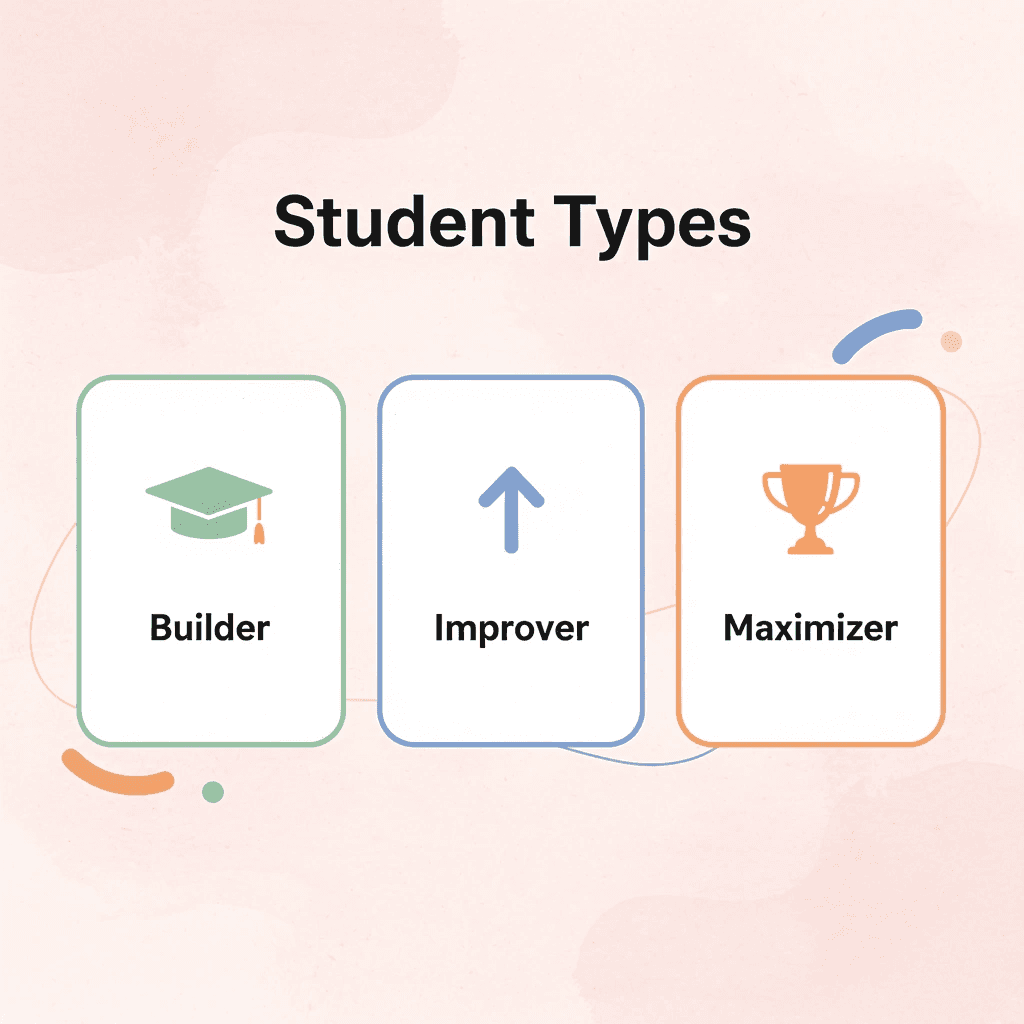
Student Type | Primary Need | Best App Feature |
|---|---|---|
Score Builder (20-25) | Foundation gaps | Adaptive lessons |
Score Improver (26-30) | Strategy refinement | Official practice tests |
Score Maximizer (31+) | Precision targeting | Advanced analytics |
💡 Tip: Download 2-3 apps for a free trial period to test which interface and teaching style clicks with your learning preferences before committing to a subscription.

1. ACT Academy
ACT Academy gives students official practice questions written by ACT, Inc., making it the most trustworthy free digital resource for question authenticity. The platform provides personalized study recommendations based on diagnostic performance and organizes content by skill area across all four test sections. Because questions come directly from ACT, the difficulty calibration and phrasing match the real test more closely than third-party approximations.
Who should consider using ACT Academy?
The platform's simple interface lacks game-like features or fancy graphics, so students who rely on external motivation through badges, streaks, or progress animations may struggle to stay consistent over several weeks of preparation. It works best for self-motivated students who prioritize content quality over app aesthetics.
2. Khan Academy
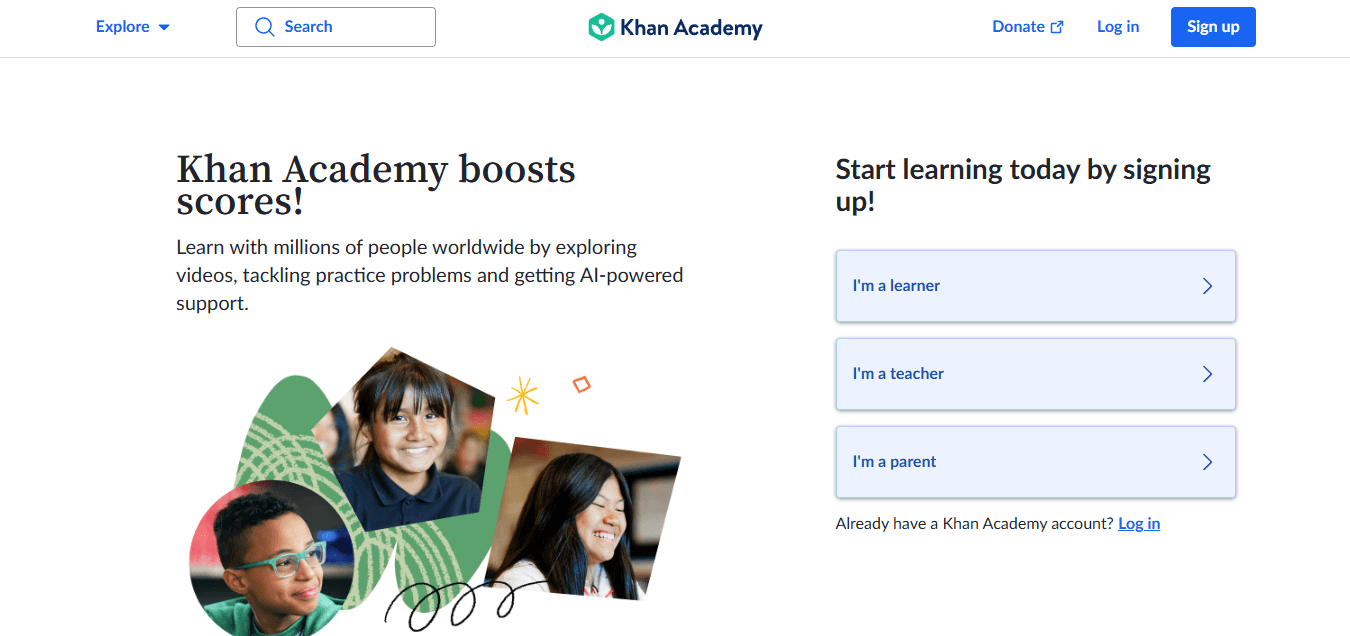
Khan Academy has a large library of academic content, making it one of the best personalized learning tools for students who struggle with the ACT due to knowledge gaps. Its adaptive recommendation engine identifies skill gaps based on performance on practice problems and directs students toward lessons and exercises that target their individual weaknesses. The math instruction covers every concept the ACT tests from pre-algebra through trigonometry, while the grammar and reading content provides a strong foundation for the English and reading sections.
How should you combine Khan Academy with other resources?
The platform is not built specifically around the ACT's format and question style, so students should supplement it with ACT-specific practice tests. According to EdisonOS, combining Khan Academy for content instruction with official ACT practice materials creates a competitive preparation ecosystem that rivals many paid alternatives. It works best for students whose score limitations stem from an incomplete understanding of the concepts tested rather than from unfamiliarity with the test format or time management.
3. Magoosh ACT Prep
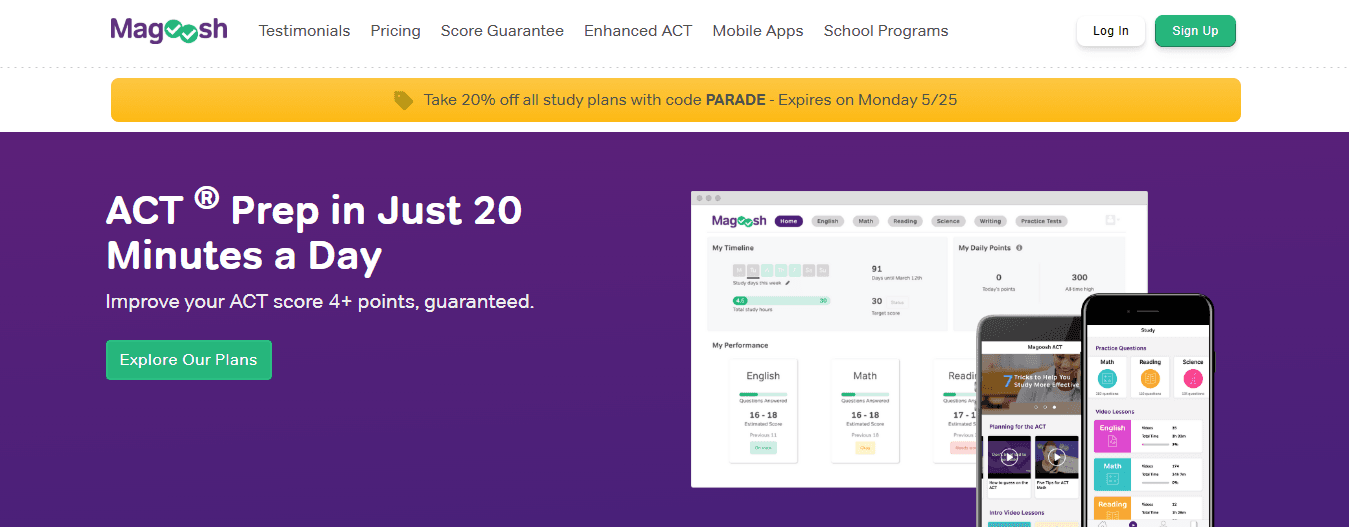
Magoosh tailors practice suggestions to each student's performance, directing them toward question types and content areas where improvement will most boost their overall score. Its video explanation library covers every major concept and question type across all four ACT sections, while its performance tracking dashboard provides constantly updated insights into strengths and weaknesses. The mobile-first design suits students studying in scattered fifteen-to-thirty-minute windows throughout a demanding school day.
The platform sits behind a paywall, creating a barrier for budget-conscious students. It works best for busy students seeking a structured, adaptive mobile preparation experience that fits into gaps in a demanding schedule.
4. Varsity Tutors ACT Prep
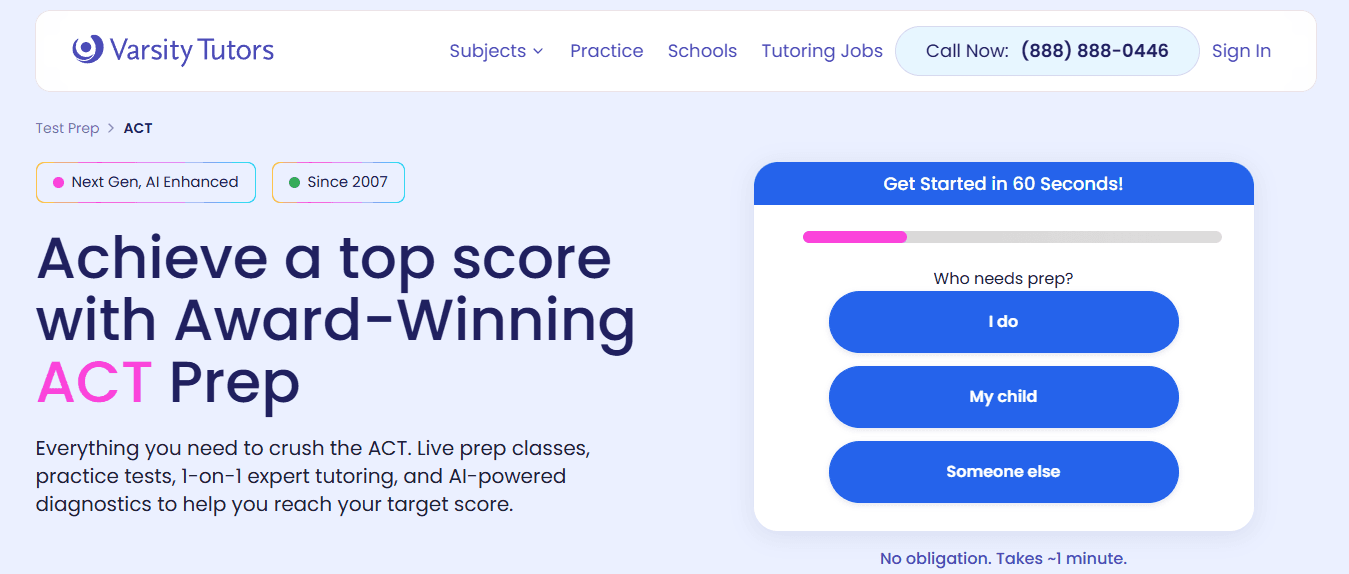
Varsity Tutors offers a complete ACT prep platform with a strong mobile experience for short daily practice sessions (15–30 minutes). Its question bank covers all four ACT sections with detailed explanations, and diagnostic tools help students identify priority areas. The platform also offers live tutoring sessions and study groups, providing flexibility for students who want human support alongside independent practice.
Who should use Varsity Tutors ACT Prep?
The free version has content limits. The full feature set requires payment. It works best for students who want to build a daily practice habit and can study during breaks or while traveling without needing a desk.
5. Quizlet
Quizlet's flashcards and spaced repetition system help you retain the vocabulary, grammar rules, math formulas, and scientific terminology tested on the ACT. ACT-specific study sets cover tested content, and the spaced-repetition algorithm optimizes review timing to support long-term memory. Its short session format suits five-to-fifteen-minute study blocks between classes, during commutes, or before bed.
What are Quizlet's limitations for ACT prep?
Quizlet focuses on memorization rather than the reasoning and comprehension skills that determine performance on challenging ACT questions. Students who rely on it as their main prep tool will not be ready for the exam's analytical demands. It works best as a supplementary tool for students with a solid primary resource who want a lightweight daily way to keep key facts active in memory.
6. Princeton Review ACT App
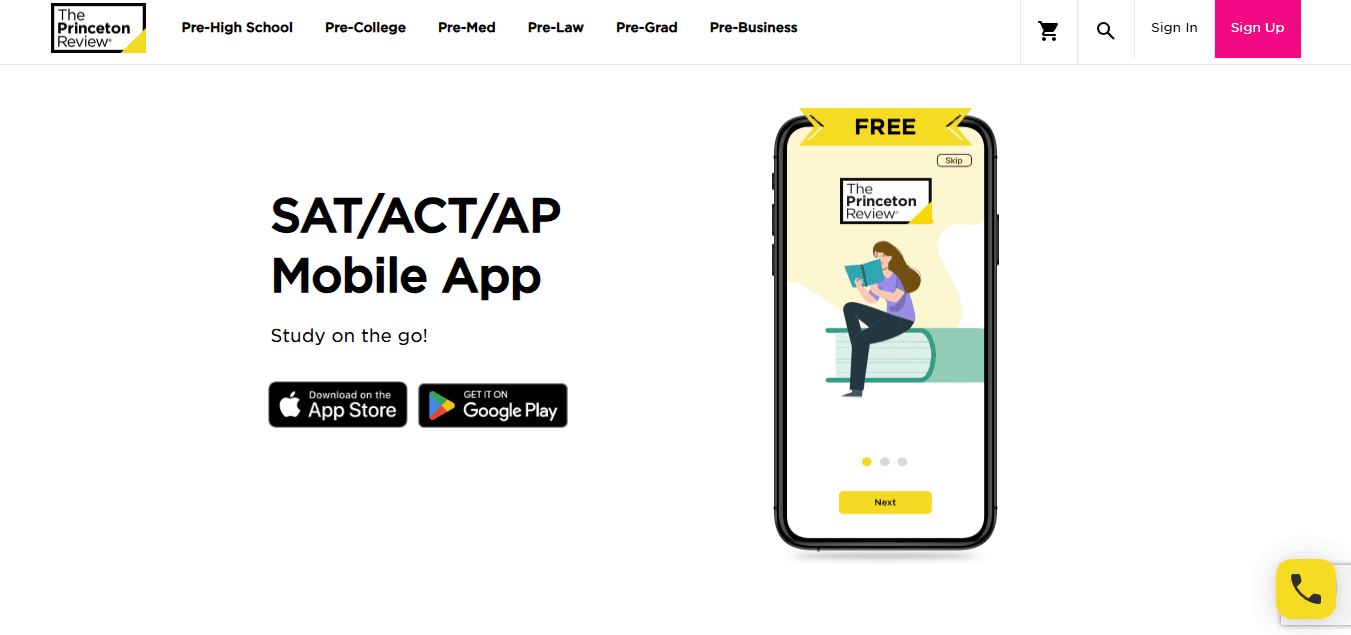
The Princeton Review's ACT app includes full-length practice tests that are among the most carefully calibrated third-party simulations of the real ACT available digitally. Its timed test interface mirrors the section structure and timing of the actual exam, with detailed score reports breaking down performance by question type, skill domain, and difficulty level.
How does the app integrate practice with targeted review?
The app connects practice test results to review content that targets specific weak areas, creating a feedback loop between testing and teaching.
Who should use this app for the best results?
The practice questions are high quality but not official ACT materials; students with access to official practice tests should prioritize those for their most important full-length simulations. The app works best for students who want multiple full-length practice tests with detailed diagnostic feedback and have exhausted or want to supplement official materials from ACT Academy.
7. Kaplan ACT Prep
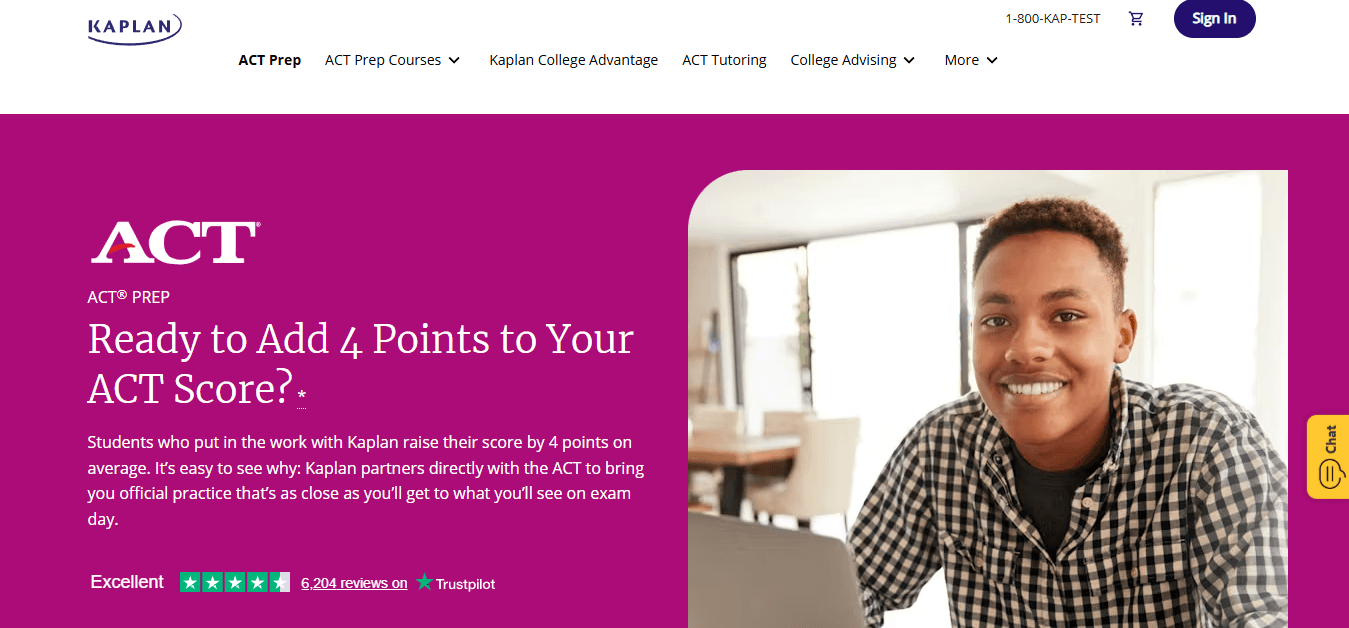
Kaplan's ACT prep app offers full-length practice tests, content review, and strategy instruction in one place. Detailed performance analytics reveal patterns across multiple attempts, helping you track improvement and focus your preparation. A score predictor estimates likely ACT scores based on practice performance, helping you decide when to take the real exam. The full feature set requires a paid subscription; free access provides only a limited preview. It works best for students seeking a single platform that combines full-length testing, analytics, content review, and strategy instruction.
8. UWorld ACT

UWorld's ACT prep app is the strongest digital option for students already performing well who want to push into upper score ranges through deep analytical review. Its question bank produces practice items that match or slightly exceed real ACT difficulty, and its answer explanations are among the most detailed available, walking students through complete reasoning rather than simply identifying correct answers. For students whose improvement depends on understanding exactly why they make specific mistakes, UWorld's explanation quality is its defining advantage.
The difficulty level and instructional depth can overwhelm students who are still building foundational skills and need accessible instruction rather than challenging questions with demanding explanations. It works best for students scoring 28–33 who want to reach the top percentile and learn through deep error analysis.
How should you choose the right ACT prep app?
Most students choose apps the wrong way. They seek the best reviews or most features instead of finding an app that solves their specific problem. A student confused by comma splices needs different tools than one with gaps in trigonometry. Both need different tools than a high scorer who understands the content but makes careless errors under time pressure. Figure out your problem first, then choose an app.
Platforms like Kollegio use diagnostic data to guide students toward the specific skills they need to develop, thereby compressing study time through targeted feedback. Taking a diagnostic test before committing to any platform reveals your starting point and weakest areas, making every subsequent test preparation choice more efficient.
What matters most for consistent app usage?
The right ACT prep app is one that a student will use consistently. A great app used occasionally cannot match a good app used daily, so ease of use, accessibility, and alignment with your study habits matter as much as content quality. A self-motivated student who values authentic practice questions will thrive with ACT Academy's simple design, while a student who needs motivational support through polished features might abandon it despite its superior content.
Students who cannot pay for subscriptions need not feel disadvantaged, as free resources like ACT Academy and Khan Academy offer content of comparable quality to many paid options. The main limitation of free platforms is typically their design and engagement features rather than teaching quality, so disciplined students can access genuine competitive preparation at no cost.
How do different score levels affect app choice?
High scorers face different challenges than students building foundational skills. A student scoring 20 on UWorld will feel overwhelmed by the difficulty, which assumes mastery of unlearned concepts, whereas a student scoring 30 on a basic-skills app will practice already-known material rather than target advanced content that separates good scores from exceptional ones.
Mobile-first design matters more for students with demanding schedules than those with consistent desk time. A student with hour-long study blocks may prefer larger screens and deeper focus, while a student whose only study time comes in fifteen-minute fragments needs an app that makes short sessions productive without extensive setup.
Content knowledge gaps require different approaches than test-taking strategy or timing issues. Khan Academy's instructional depth makes it strongest for students whose low scores reflect incomplete conceptual understanding, while apps focused on test-specific strategies serve students who know the content but struggle to apply it efficiently under exam conditions. But even the best-matched app only works if students use it consistently, and consistency breaks down when practice feels disconnected from actual score improvement.
Why Practice Questions Alone Rarely Raise ACT Scores
Practice questions show where students struggle, but they don't solve the problem. A student can complete 500 English questions and still make the same comma splices, sentence boundaries, and modifier mistakes because repeating errors without fixing them reinforces wrong patterns rather than eliminating them.
🎯 Key Point: Simply grinding through practice problems without targeted error correction reinforces bad habits rather than eliminating them.
"Students who focus solely on practice volume without addressing their specific weaknesses see minimal score improvement despite completing hundreds of questions." — ACT Prep Research, 2023
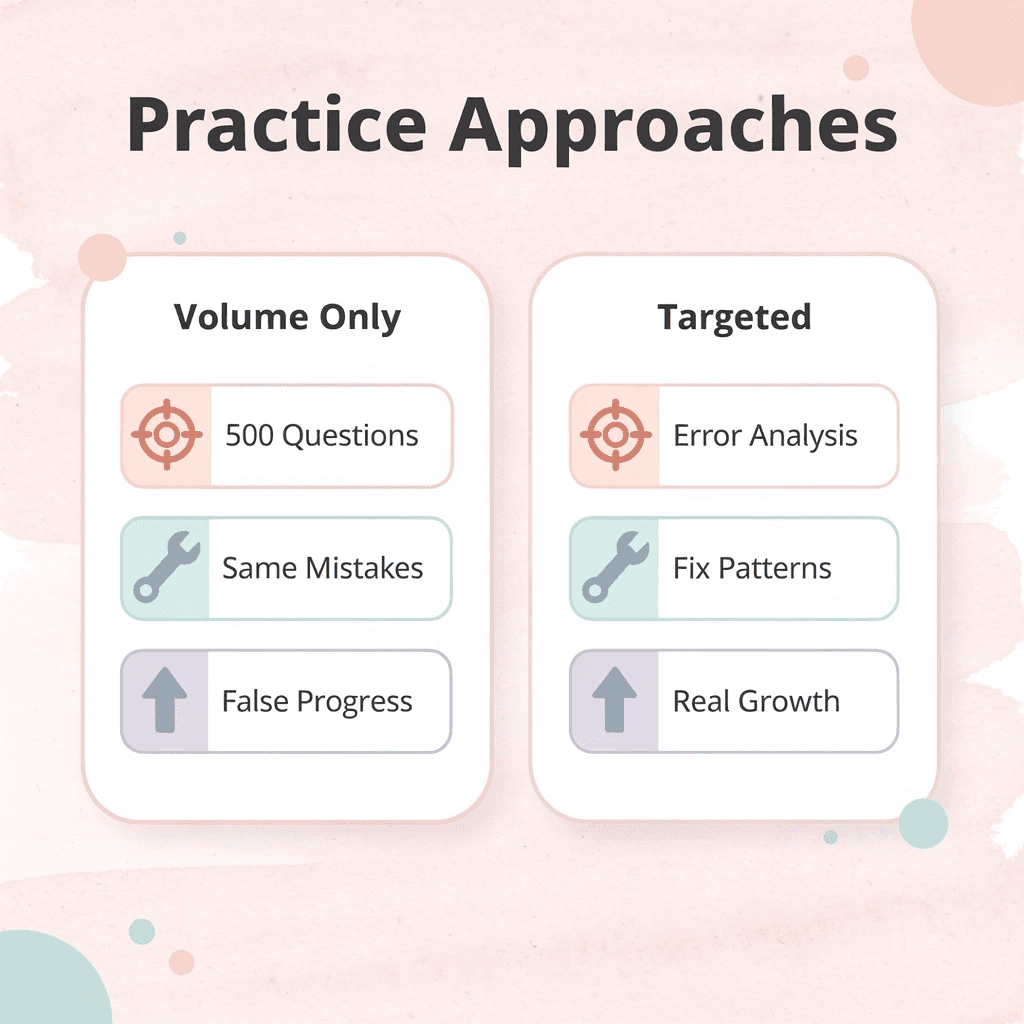
⚠️ Warning: Repetition without correction creates false confidence - students think they're improving when they're actually cementing mistakes into their test-taking approach.
What makes repetition feel like progress?
Finishing many questions can feel like progress. Students track how many they've completed, celebrate milestones, and feel more confident as their workload grows. But quantity doesn't equal improvement.
Why does practicing without understanding fail?
One student who failed the NCLEX after completing 1,830 practice questions discovered the problem wasn't hard work or question volume: she never identified which categories consistently tripped her up or why her reasoning led to wrong answers. She was practicing mistakes repeatedly. The ACT works the same way. If a student doesn't understand why restrictive clauses need different punctuation than nonrestrictive ones, answering 200 mixed grammar questions won't teach that difference—it will only confirm the confusion 200 times.
What Separates Improvement From Motion
Students who raise their scores spend more time analyzing wrong answers than moving to the next set. They treat each mistake as helpful information: Why did I choose that answer? What rule or concept did I not understand? Where else does this pattern appear? That review process transforms practice from repetition into real learning by fixing the underlying weakness rather than skipping over it. Research on retrieval practice and corrective feedback consistently shows that testing combined with explanation produces stronger retention than testing alone. Practice reveals the problem; review solves it.
Why does the targeted study outperform the high-volume practice?
Consider a student who misses 12 English questions on a practice section. After reviewing the results, she discovers seven involve punctuation rules, three involve sentence boundaries, and two involve rhetorical skills. The most effective next step isn't another 200 mixed questions; it's reviewing punctuation concepts, practicing targeted punctuation drills, and rechecking similar questions until accuracy improves. Future practice tests often show measurable gains in scores because the root cause has been addressed.
How do apps identify your specific weaknesses?
Most prep apps focus on question counts because volume is easy to measure and gamify. Platforms like Kollegio's AI college counselor work differently by analyzing how students perform across practice attempts and highlighting recurring weak spots, so students spend time on what matters rather than chasing high question counts that don't improve scores. But knowing which weak spots to work on only helps if students incorporate those fixes into a structured study plan.
Related Reading
- What's A Good Act Score
- When Should I Start Studying For The Act
- Act Grammar Rules
- Do Colleges Prefer Act Or Sat
- What's A Good Sat Score
- Best Sat Prep Apps
- Best Sat Prep Books
- Best Sat Practice Tests
How to Build an ACT Study Plan Around Prep Apps
Start with the Diagnostic, Not the Streak
Most students open an ACT prep app and immediately start answering questions, building a streak, and assuming they're making progress. Without understanding your baseline performance across sections, you're practicing blindly. Every effective study plan begins with a diagnostic assessment that reveals where you stand: which sections consume the most time, which question types consistently trip you up, and your current score range. This information determines whether you need to spend the next month on algebra fundamentals or reading inference strategies.
Map Weaknesses to Daily Practice Blocks
Once the diagnostic shows your gaps, turn those results into focused study sessions. If punctuation rules cost you six points on the English section, prioritize grammar drills over reading comprehension exercises you already handle well. If quadratic equations appear in your error log repeatedly, prioritize algebra practice. According to PrepScholar's ACT study schedules, students who target specific skill gaps rather than cycling through random question sets see measurable improvement within weeks. The goal is to eliminate the recurring mistakes that suppress your score.
Build Timing into Section Drills
Understanding the content is only half the challenge. The ACT penalizes slow decision-making as much as incorrect answers. After addressing individual skill gaps, students need to practice under realistic time constraints. Most prep apps offer timed section drills that simulate test day: 45 minutes for English, 60 minutes for Math, 35 minutes for Reading, 35 minutes for Science. These sessions expose another weakness: you might understand coordinate geometry perfectly, but lose points when forced to solve problems in 90 seconds rather than five minutes. Pacing strategies matter as much as content mastery.
Review Every Practice Test Like It's the Real Thing
Full-length practice exams build endurance, reveal timing problems across four sections, and simulate the mental fatigue that affects later performance. However, the review process—not the exam itself—determines whether the test produces improvement or frustration. After completing a practice exam, analyze every incorrect answer: Was it a content gap, careless error, or timing issue? Did you misread the question, forget a formula, or run out of time? Many prep apps provide detailed explanations, but students often skip this step to start the next test. That's when practice becomes repetitive without being productive.
How does consistent practice outperform cramming sessions?
Platforms like Kollegio's AI college counselor analyze your performance across practice attempts, identifying patterns in your struggles and adjusting recommendations as you improve. Rather than following generic schedules, our AI college counselor provides guidance tailored to your mistake patterns and available time. This prevents you from spending hours on material you already know while neglecting question types that lower your score.
What makes an effective ACT study plan?
The strongest ACT study plans identify specific weaknesses, address them with focused practice, and measure improvement through timed drills and full-length exams. Apps become valuable when they support that feedback loop rather than simply provide more questions. But ACT preparation is only one part of the college application process, and a higher score matters only if it strengthens the rest of your application.
How Kollegio Helps Students Turn ACT Preparation Into Stronger College Applications
A stronger ACT score opens doors, but walking through them requires different skills: knowing which schools match your profile, which scholarships align with your achievements, and how to present your story compellingly. Most students improve their scores without connecting those results to a clear application strategy.

🎯 Key Point: ACT preparation becomes exponentially more valuable when it's integrated with college application planning from the start, rather than treated as an isolated test prep activity.
"Students who combine test prep with strategic college planning are 40% more likely to gain admission to their top-choice schools compared to those who focus solely on score improvement." — National Association for College Admission Counseling, 2023

💡 Tip: The most successful students use their ACT preparation timeline as a framework for building their entire college application strategy, ensuring every hour of study contributes to both higher scores and stronger applications.
Align Your Score With the Right Schools
Students often build college lists based on rankings or assumptions rather than fit. A 30 ACT might be competitive at one school and below average at another. Understanding where you fall within each institution's admitted student profile requires evaluating academic thresholds, geographic preferences, and program strengths. According to ACT Industry Insights, students have access to $3.5 billion in scholarships, but finding opportunities that match their specific profiles requires strategic planning. Our Kollegio AI college counselor matches students with schools where their ACT performance enhances their competitiveness, eliminating guesswork from list-building.
Tell a Story That Goes Beyond Numbers
Admissions officers read hundreds of applications each cycle. Your ACT score demonstrates college readiness, but your essays explain why you want to study environmental science or what that summer internship taught you about community health. Essay feedback tools help students identify where their stories lose focus or fail to connect their activities to their goals, thereby strengthening their applications without writing them for them.
Present Activities With Clarity
Many students list activities like "Member, Debate Team" without context. Instead, explain that you researched policy briefs for 15 hours weekly, mentored new debaters, and placed third at regionals. Specific details demonstrate commitment and leadership, helping admissions officers understand your impact.
Keep Everything in One Place
College applications scatter information across portals, spreadsheets, email threads, and handwritten notes. Deadlines arrive faster than expected, recommendation requests get lost, and students forget which schools require additional essays. Centralized planning tools reduce the mental load of tracking requirements across multiple institutions, letting students focus on quality rather than logistics. Kollegio, an AI-driven platform for college applications, consolidates college matching, scholarship discovery, essay development, and deadline management, so students spend less time on organization and more time refining their applications. But even with stronger scores, better essays, and organized deadlines, one question remains unanswered.
Use Kollegio's AI College Counselor for Free Today!
Raising your ACT score strengthens your application, but it represents one part of what admissions committees evaluate. Kollegio's AI college counselor helps you turn that score into a strategic advantage by matching you with colleges where your profile fits competitively, identifying scholarships aligned with your academic strengths, and clarifying which application elements deserve your attention next. You get personalized guidance typically reserved for students who pay thousands for private counseling, except our AI college counselor provides it free.
💡 Tip: Your ACT score opens doors, but strategic college matching ensures you walk through the right ones for your profile and goals.
"Students who receive personalized college counseling are 3x more likely to gain admission to their target schools and secure merit-based scholarships." — National Association for College Admission Counseling, 2023

Start your first session today. Within minutes, you'll receive college matches based on your actual academic profile, discover scholarship opportunities you qualify for, and identify specific next steps that strengthen your application beyond standardized testing.
🔑 Takeaway: The real advantage comes from knowing exactly which colleges value your unique profile and how to position yourself competitively.
Traditional Approach | AI-Powered Strategy |
|---|---|
Focus only on test scores | Optimize entire application profile |
Generic college research | Personalized matches based on your stats |
Miss scholarship opportunities | Discover targeted scholarships you qualify for |
Guess at next steps | Get specific action items prioritized |
Related Reading
- Best Sat Prep Books
- How Many Reading Questions Are On The Sat
- Do Colleges Prefer Act Or Sat
- When Should I Start Studying For The Act
- Sat Grammar Rules
- Best Sat Prep Apps
- What's A Good Act Score
- How To Prep For Act
- Best Act Prep Books
- Best Sat Practice Tests
- Act Grammar Rules
- What's A Good Sat Score

Author
Senan KhawajaSenan Khawaja is the Co-Founder and CEO of Kollegio, an AI-native college counseling and institutional recruiting platform serving roughly 250,000 students across 190 countries. A Stanford graduate, repeat founder, and Forbes 30 Under 30 honoree with World Bank experience, Senan launched Kollegio to democratize elite college counseling—addressing the 400:1 student-to-counselor ratio in public schools. Under his leadership, Kollegio has secured 22+ institutional partners with a 100% renewal rate and backing from Reach Capital, JFF Ventures, and ECMC Group. He was also selected for OpenAI's inaugural ChatGPT Futures Class of 2026. Senan is based in New York City.